Listen on Spotify

Why is the live event missing from the carousel?

Cold open

The event is live. Production is ready. Social has posted. The programming team refreshes the home screen and sees yesterday's featured tile still smiling back with unjustified confidence.

The live event exists in the schedule, in the CMS, and in at least three Slack messages insisting it should be visible by now. To the customer, however, it may as well be a rumor.

HR-Z0 case note: if visibility is manual, revenue windows close automatically.
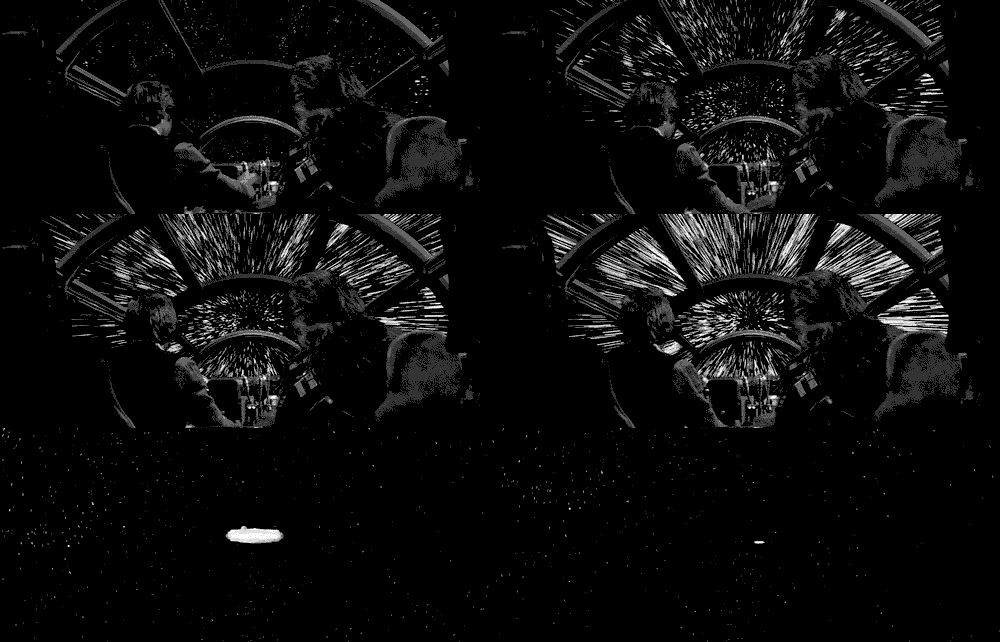
The horror

When live content misses the carousel, the symptoms are immediate:

Symptoms

The symptoms are always recognizable:

  • discovery fails at the most valuable moment
  • programming blames metadata
  • editorial blames scheduling
  • product blames feed logic
  • support gets questions it cannot answer

This is not just a UI issue. It is revenue, audience trust, and live-ops credibility collapsing into the same awkward refresh loop.

Cost

The cost is not abstract.

  • Time: responders spend midnight cycles correlating logs across tools that were never wired to agree.
  • Money: each silent failure taxes release velocity and turns routine updates into incident programs.
  • Trust: product teams stop trusting the pipeline when "green" and "working" are different states.

The root cause

Outages rarely begin at the alert. They begin where observability, ownership, and retry rules were left vague.

1

Ownership is distributed past usefulness

Programming, editorial, metadata, and platform teams all influence featured placement. If no one owns the final "is it live and visible?" outcome, everyone owns a percentage of the miss.

2

Publish rules are fragile

Carousel behavior often depends on schedule windows, entitlement rules, metadata completeness, feed timing, and ranking logic. Weakness in any one of them can hide a live event.

3

Feed checks are too reactive

If teams verify placement by opening the consumer experience after go-live, detection is already late.

4

Response ownership starts after impact, not before

If teams verify placement by opening the consumer experience after go-live, detection is already late.

The fix

The fix is a response system, not another after-hours hero story.

1

NorthStar maps the live event chain

NorthStar identifies how an event moves from schedule to metadata to feed to featured placement, and where the handoffs currently break.

2

Astro hardens the publishing workflow

Astro helps establish:

  • clearer event-to-carousel rules
  • pre-flight checks for live placement
  • monitoring for missing featured content
  • explicit ownership for go-live visibility

Where collaboration between teams is the real failure point, Orion helps structure the operating rhythm and shared handoff model.

3

Response loops are codified, timed, and testable

Retry strategy, escalation thresholds, and rollback routes are documented as operating behavior, not tribal knowledge. Incidents become shorter and less theatrical.

Live content that cannot be found is just very expensive secrecy.

HR-Z0
HR-Z0
Comms Officer

Comms Officer HR-Z0 (a.k.a. “H.R. Zero”) is Galaxie’s deadpan broadcast voice for the Office Horror Stories series — part dispatcher, part incident historian, part morale damage control.
Built from equal parts helpdesk transcripts, post-mortems, and calendar trauma, HR-Z0 doesn’t “tell stories.” It files reports from the front lines of messy operations — where ownership evaporates, folders time-travel, and a “quick change” becomes a six-month saga.

Give us a call

Available from 9am to 8pm, Monday to Friday.

Send us a message

Send your message any time you want.

Our usual reply time: 1 Business day